The environment
Environmental issues are a priority at Swedavia, and Visby Airport works continuously in a number of different areas to reduce its environmental impact.
Swedavia's climate work
Our zero vision
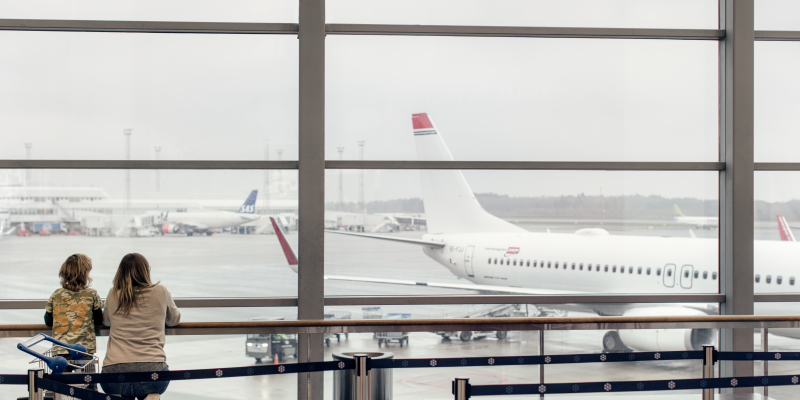
In 2020, Swedavia achieved the company’s goal of no fossil carbon dioxide emissions from airport operations run under our own management.
Extensive work underpins our success in achieving zero fossil carbon dioxide emissions. We purchase renewable electricity for all our operations, the back-up power supply runs on hydrotreated vegetable oil (HVO100), our vehicle fleet runs on HVO100, fossil-free gas or renewable electricity, and we purchase liquefied petroleum gas (biogasol) and biogas.
At the end of 2025, Swedavia reached its next climate target, as all permanent or recurring actors at the airport use only fossil‑free energy in their airport operations. The work is aligned with the IPCC’s 1.5‑degree scenario and Swedavia’s strategy and goals for a proactive climate transition.
Swedavia’s climate roadmap describes how the company contributes to the climate transition. It covers both the transformation of its own airport operations and the joint efforts with airlines, ground handling companies, suppliers, and authorities. The roadmap shows how measures and collaborations are interconnected and how Swedavia is working step by step to achieve the goal of fossil‑free operations by 2050.
More about the aviation sector’s transition and how Swedavia is working towards fossil free airports
Airport Carbon Accreditation (ACA)
Airport Carbon Accreditation is a framework within Airport Council International (ACI) which evaluates airports' work with handling and reducing their carbon dioxide emissions. The framework has seven levels, where 5 is the highest.
All of Swedavia’s airports are accredited at least at the ACA4+ level in accordance with Airport Council International (ACI) Europe’s standards for the climate work of airports. The next goal is to have all the airports accredited at the ACA5 level, which means that we will increasingly engage and collaborate with other stakeholders with significant carbon emissions at the airports in order to continue reducing emissions together.
Seven of Swedavia's ten airports have been certified at the highest level, ACA5; Stockholm Arlanda Airport, Göteborg Landvetter Airport, Malmö Airport, Åre Östersund Airport, Visby Airport, Ronneby Airport and Kiruna Airport. The three remaining airports – Bromma Stockholm Airport, Luleå Airport and Umeå Airport, will be certified according to ACA5 during 2026.
The airport’s carbon footprint
For greenhouse gas reporting, 2010 has been established as the base year for Scope 1 and 2. For all Scope 3 categories, 2019 has been set as the base year. The different base years have been selected based on the availability of consistent and verifiable data sets, as well as to avoid the effects of the pandemic.
Emissions for the current year (2025) have been calculated using the same organizational boundaries and methods as for the base years to ensure comparability over time. Any recalculations of the base year have been carried out in accordance with ACA guidelines to reflect methodological improvements or structural changes.
Visby Airport has reduced its Scope 1 and 2 emissions by 282 tonnes of CO₂e, excluding de-icing, which corresponds to a 99 percent reduction compared with 2010. In 2010, Scope 1 and 2 emissions amounted to 284 tonnes of CO₂e, while in 2025 they amounted to 1.6 tonnes of CO₂e. Including de-icing, Scope 1 and 2 amounted to 344 tonnes of CO₂e in 2010 and 23.4 tonnes of CO₂e in 2025. A certificate for carbon removal amounting to 24 tonnes of CO₂e (which exceeds the Scope 1 and 2 emissions) is available at Certificate carbon offset removal Visby Airport.
In 2019, Scope 3 emissions amounted to 7 660 tonnes of CO₂e, decreasing to 5 084 tonnes of CO₂e in 2025.
Certificate
Environmental impact

Climate change is a key issue for the development of civil aviation, and Malmö Airport works actively in several areas in order to minimise the negative environmental impact of our operation.
Noise
The airport works very actively with residential planning. By changing approach and landing methods to the south of the airport and by holding meetings with pilots and air traffic controllers, efforts are made to limit noise exposure for residences and other operations that are sensitive to noise. The airport is located near the sea so only short flight paths over land are needed for current routes because most commercial traffic heads for the Swedish mainland.
Air
The biggest source of carbon dioxide emissions at the airport are the aviation operations run by the different airlines. Aircraft emissions consist mostly of combustion gases. Other emissions are produced by ground transport to and from the airport. The Swedish aviation industry aims to be completely fossil-free by 2030 (domestic travel).
Airport operations include the heating of properties. Heating is provided by heat pumps and green electricity. Swedavia’s own carbon dioxide emissions only from renewable forms of energy do not contribute to net carbon dioxide emissions in the atmosphere.
Soil and water
Surface water from aircraft parking stands and the runway is collected and reused. Residue from the urea used for runway anti-skid treatment is picked up in the flow of surface water, and the nitrogen contained in it fertilises a nearby golf course when it is watered. Reusing the airport’s surface water reduces the use of both groundwater and mineral fertiliser. Surplus glycol from the de-icing of aircraft is collected separately, excess water is removed, and the product is used as new de-icing fluid.
Firefighting exercises mainly use biogasol as a fuel and only water as an extinguishing agent. This prevents the emission of unburnt fuel into the atmosphere and the discharge of extinguishing agent residue into the soil.
Sampling of run-off, groundwater and surface water is carried out in compliance with control programmes. Soil samples are also taken in conjunction with groundwork. There are residues of coal tar from older layers of asphalt.
PFAS
Background
PFAS is an umbrella term for a large group of perfluorinated organic compounds. These compounds are very useful chemicals and are still employed in many ways in society, including in textile production, surface treatment of different materials, and different kinds of hydraulic systems. PFAS compounds were also used in firefighting foam. Firefighting foam containing PFAS compounds was used at Visby Airport for decades, until the early 2000s, when it was discovered that these compounds were potentially toxic. In 2008, an internal ban on PFAS was introduced, three years before such firefighting foam was prohibited by law in 2011.
Swedavia' work
We work with action plans for contaminated soil and follow regulatory recommendations for surveying and measures to be taken. Since the winter of 2017-2018, the surface water collected at Visby Airport is collected through a charcoal filter and then used to water the Gotska Golf Club’s golf course adjacent to the airport. About 25 million litres of surface water are treated each year.
Firefighting foam was mainly used at Visby Airport at its firefighting exercise site before 2008. Swedavia has delimited the area affected and identified about 30 properties with their own well whose water was affected by PFAS. These properties have been connected to the local water supply or had a charcoal filter installed. Work is currently under way to minimise the continued spread of PFAS.
Further information about PFAS, for instance which regulatory agency is responsible for what kind of work with contaminants, can be found on the Swedish Chemicals Agency’s website.
Biodiversity
Large parts of the airport area are managed as hay meadows, where many different species of plants and animals are found. A number of insects and plants found on the EU’s Red List of threatened species are found in the grasslands, limestone planes and shrublands in the airport area.
Environmental permit
The aim of the application is to obtain a permit based on current environmental laws, the Swedish Environmental Code, and to safeguard operations over the long term. As a result of the ruling, among other things, a decision on the final conditions for surface water was postponed for a trial period. During the trial period, Swedavia carried out studies, the results of which were submitted on August 31, 2021. Visby Airport awaits a decision on the final conditions regarding the treatment of surface water. The environmental permit regulates, among other things, civil och military flight paths, noise levels, chemical and waste management, and the airport’s emissions.
Environmental report
Environmental report Visby Airport 2025 (pdf, in Swedish)
F17 information (pdf, in Swedish)
Environmental projects
Infrastructure investments for electric aircraft
With the help of the Swedish Environmental Protection Agency’s Klimatklivet project and in partnership with GEAB and Region Gotland, two charging points for electric aircraft have been installed by Swedavia. The investment in electric aircraft is an important part of the aviation industry’s transition to net zero operations. On October 1, 2021, the first electric aircraft landed at Visby Airport and the charging points were inaugurated.
Smartroad Gotland
A pilot facility with a unique inductive, dynamic power transmission system has been set up at Visby Airport and along the road leading to central Visby. A lorry and an airport bus serve as test vehicles on the world’s first wireless electrified road for buses and heavy lorries. Electreon developed the charging technology, and the project is being funded by the Swedish Transport Administration. Take the opportunity to travel with Smartroad Gotland’s airport bus this summer.
Energy efficiency measures
The airport works actively to reduce energy use. Air source heat pumps are being installed, thus replacing direct-acting electricity and the wood pellet-burning boiler that previously heated some buildings.
Soil remediation trial
In conjunction with Svevia, NIRAS and Örebro University, a trial is under way to clean soil contaminated with PFAS. Analyses carried out on a laboratory scale show good results. Soil remediation may be a way to prevent the continued spread of PFAS compounds from areas contaminated in conjunction with previous firefighting exercises (before 2008).
Purpose and objectives
Swedavia owns, operates and develops airports and properties near these airports in Sweden. We strive to continuously improve our management system (ISO 14001) to minimize our environmental impact and use resources in a sustainable manner throughout the value chain. This is done primarily by reducing greenhouse gas emissions, where we shall maintain at least 90 percents emissions reductions in Scope 1 and 2 and reach net zero in Scope 3 by 2050 at the latest, aligned to applicable net zero frameworks.
We shall also minimize other atmospheric emissions and discharges to soil and water and minimize the use of harmful chemicals. Through systematic work with climate analyses, we adapt to the changing climate. Swedavia shall promote biological diversity, secure effective management of resources in order to contribute to circular economy, and continuously work to improve energy efficiency.
For us, it is a given that we comply with environmental and energy statutes in effect as well as other applicable national and international regulations and requirements. It is also a given that we ensure access to the information and resources required to achieve our environmental and energy objectives and targets. We shall also work to limit aircraft noise and emissions from aircraft operations.
In order to achieve this, working in accordance with the following fundamental rules is required:
- Environmental concern is integral to every part of operations and is taken into consideration in every decision.
- The most important environmental issue for the aviation and real estate sectors is their climate impact, and this must be given priority in decisions and activities.
- We shall continuously improve energy efficiency and manage our own operations as well as influence other companies and organizations that we interact with for the sustainable use of resources.
- We shall purchase energy-efficient products and services and promote construction that leads to better energy performance.
- All of Swedavia´s employees shall take part in our environmental and energy work.
- We shall assess and manage environmental risks and energy performance in a systematic manner.
- Swedavia shall take an active part in local, regional, national and international work in order to reduce the aviation industry´s negative impact on the environment and work for the sustainable development of airports
Track flights
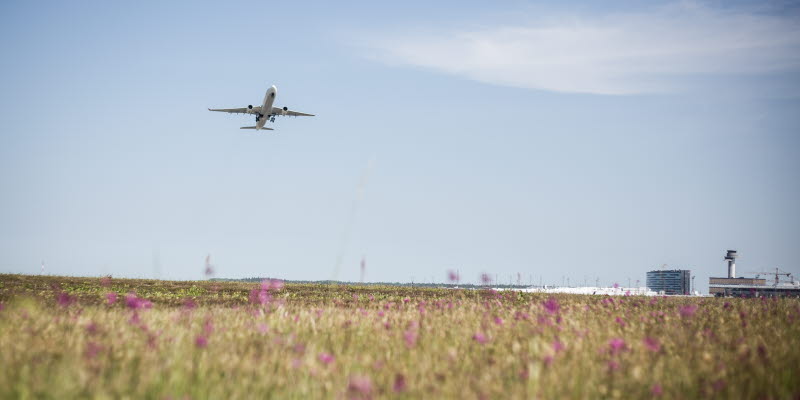
One public tool available for use is Flightradar24.com.
The Webtrak tool that we previously made available here on our website is being reviewed, and we are exploring the possibilities of using other data sources. This is in order to once again enable people living in the vicinity of our airports to track air traffic movements and link this information to aviation noise measurements where available.